
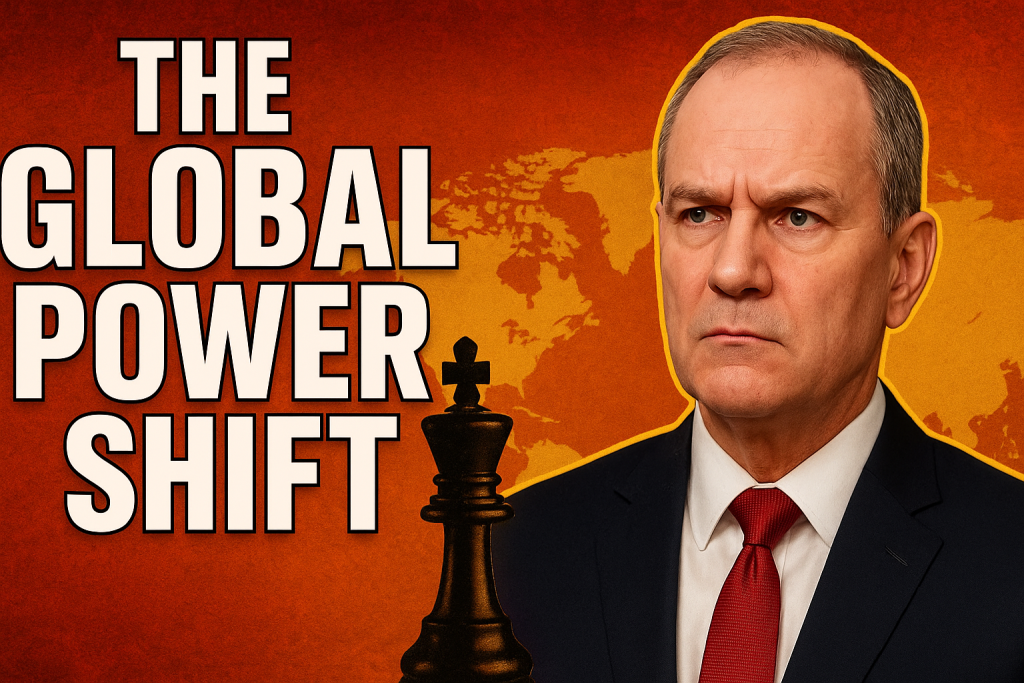
A New Era of Global Leadership
For years, experts have warned that the world is entering a major rebalancing of power, and now, it’s happening in real time. What we’re witnessing isn’t chaos for chaos’s sake; it’s a strategic jockeying for world leadership between the planet’s most powerful nations: Russia, China, the United States, and India.
The United States, once the uncontested global superpower, is slowly losing its position at the top. The emerging nations know this. They’re not just reacting, they’re planning for the next world order.
The Global Chessboard: Power Plays & Alliances
As the speaker explains, this isn’t random geopolitical noise. It’s chess on the world stage.
Each country is maneuvering carefully:
- Russia asserts dominance through energy, military, and regional influence.
- China expands its reach through global trade, digital currency, and infrastructure (the Belt & Road Initiative).
- India rises as a key player, balancing alliances between East and West.
- Meanwhile, the United States struggles to maintain influence amid economic debt and internal division.
Behind the scenes, other nations Saudi Arabia, Iran, Israel, and Pakistan, are also advancing their agendas, leveraging oil, gold, and digital assets to strengthen their geopolitical footing.
The Petro-Dollar Era Nears Its End
One of the biggest shifts lies in the collapse of the petro-dollar system, which made Saudi Arabia and its allies rich for decades. Those nations now seek to secure dominance beyond oil through resources, trade alliances, and new currencies backed by gold or blockchain.
This global “power grab” isn’t about cooperation; it’s about total and complete domination. The psychology of leadership at this level demands nothing less. Each leader aims to “take the entire pie” to control not just their own nations, but the rules of the world economy itself.
America’s Decline Is No Accident
According to the analysis, the United States losing global dominance isn’t a surprise; it’s a planned transition that’s been unfolding for decades.
Even figures like Donald Trump, once seen as defending U.S. strength, are now positioning themselves for the post-American era. The creation of Trump-branded digital assets and stablecoins signals how power players are moving toward private, blockchain-based wealth systems to preserve influence as traditional finance crumbles.
The chaos we’re witnessing, economic instability, political tension, and financial realignment, is part of this grand design. The old system is dying; a new one is taking shape.
Understanding the Psychology of Power
The speaker highlights an uncomfortable truth: world leaders are driven by domination psychology.
To rise to global leadership, one must have an insatiable desire for control. This mindset fuels both innovation and destruction; it’s the same energy that builds empires and brings them down.
The current power struggle is not about ideology or morality; it’s about who owns the future resources, digital currency, data, and influence.
What Lies Ahead
As the system evolves, expect more:
- Financial realignments (new currency blocs and reserve systems).
- Regional alliances between former rivals.
- Increased volatility in global markets as new digital economies emerge.
The fall of one empire always marks the rise of another. The 2020s are shaping up to be the decade when global leadership fragments, giving rise to multi-polar power, no longer one world leader, but many competing centers of influence.
Final Thought
What we’re seeing isn’t the end of civilization; it’s a massive power recalibration. The United States’ decline, China’s rise, Russia’s strategic persistence, and India’s quiet growth all point toward the same reality:
The era of one global superpower is over.
The era of many powerful nations has begun.
The key for individuals, investors, and nations alike is to adapt quickly to understand that the world’s next phase will reward agility, insight, and sovereignty over blind loyalty to old systems.