
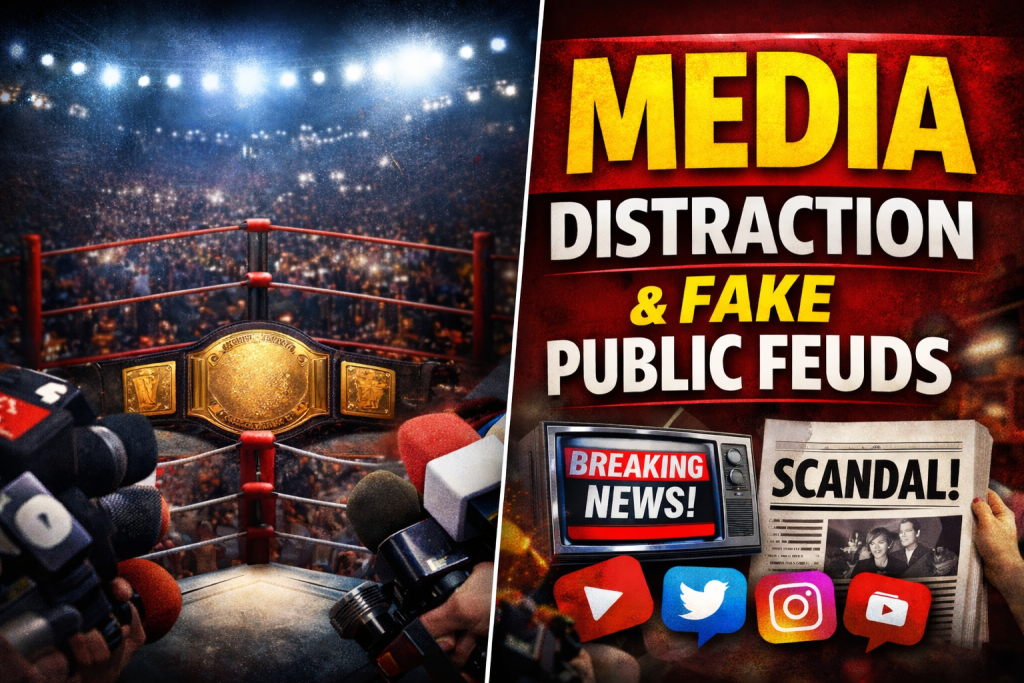
Media Distraction has become one of the most powerful tools shaping modern public discourse. Instead of focusing on meaningful investigations, global issues, or accountability, audiences are increasingly pulled into nonstop personality conflicts that resemble entertainment more than journalism.
In today’s digital landscape, Media Distraction thrives on emotional reactions, constant drama, and repeat exposure—keeping viewers locked into cycles of outrage rather than awareness.
Media Distraction Through Celebrity Feuds
One of the clearest examples of Media Distraction is the way public figures are pitted against one another in highly dramatized conflicts. What begins as legitimate criticism or debate often morphs into a continuous spectacle—less about truth and more about clicks, views, and dominance.
These feuds are framed like professional wrestling storylines:
- Constant callouts
- Escalating confrontations
- Carefully timed “reveals”
- Endless commentary loops
The result is a distraction-driven narrative that replaces serious discussion with entertainment-style conflict.
How Media Distraction Shifts Public Attention
While attention is consumed by viral clashes, deeper topics quietly disappear from public focus. Investigative journalism, policy discussions, international developments, and economic realities are pushed aside in favor of drama cycles designed to maximize engagement.
This pattern aligns with well-documented media behavior, where conflict-based content outperforms factual reporting in algorithms and monetization systems. You can learn more about this phenomenon from trusted sources like:
- BBC analysis on media narratives: https://www.bbc.com
- Wikipedia’s overview of media manipulation: https://en.wikipedia.org/wiki/Media_manipulation
- The New York Times on attention economics: https://www.nytimes.com
Why Media Distraction Works So Well
Media Distraction succeeds because it appeals to emotion rather than reason. Anger, loyalty, fear, and outrage keep people watching—even when the content provides little real value.
As a result:
- Audiences become polarized
- Complex issues are oversimplified
- Truth becomes secondary to spectacle
The longer the feud continues, the less room there is for nuanced thinking or meaningful accountability.
Moving Beyond Media Distraction
Recognizing Media Distraction is the first step toward escaping it. Instead of focusing on personalities, meaningful progress comes from examining ideas, systems, and long-term consequences.
As the saying goes:
Small minds discuss people. Average minds discuss events. Great minds discuss ideas.
In an era dominated by Media Distraction, choosing ideas over drama is an act of awareness—and power.